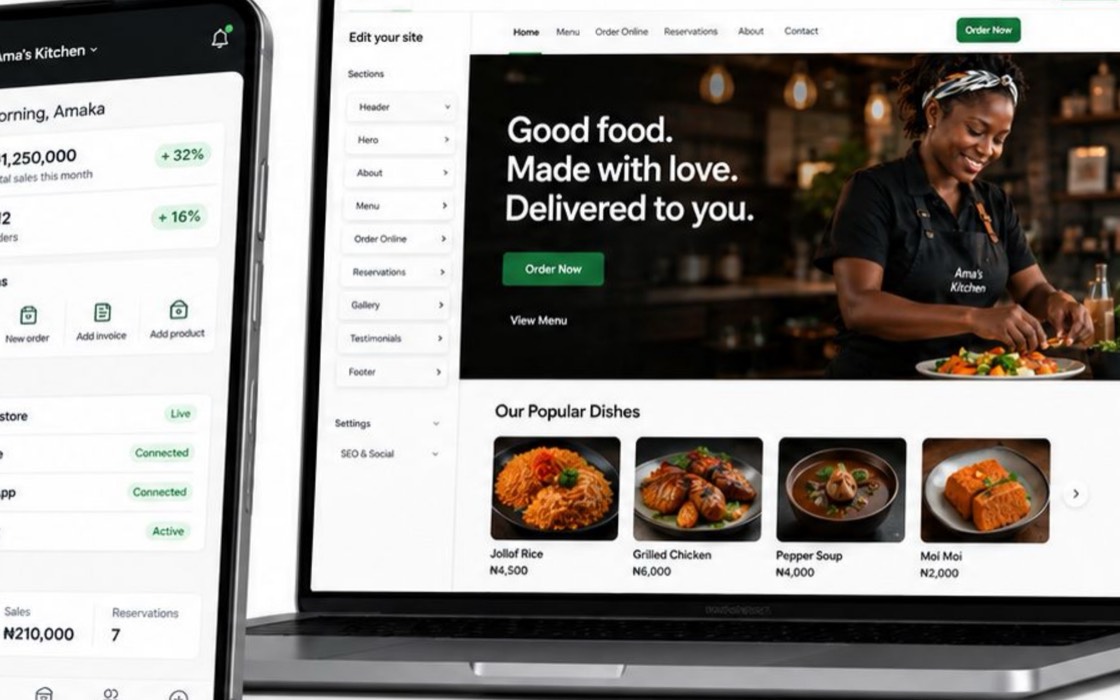

A continental market needs more than a payment rail.
AfCFTA establishes the trade framework. PAPSS connects participating payment institutions. Commerce software gives businesses the tools to create, accept, fulfil, and understand the transactions that move across those systems.

Three layers, three different jobs.
These systems are related, but they are not interchangeable. Keeping their responsibilities separate makes the opportunity easier to understand.
AfCFTA sets the trade framework. The African Continental Free Trade Area creates a legal framework for progressively liberalised trade in goods and services. Tariff schedules, rules of origin, customs processes, and national implementation still determine what applies to a specific transaction.
PAPSS moves the payment. Participating banks and payment providers can send payment instructions through shared infrastructure so a payer uses local currency and a beneficiary receives local currency.
Commerce creates the transaction context. Products, orders, customers, locations, channels, taxes, fulfilment, and payment outcomes are the operating records around the movement of money.
What PAPSS does and what it does not do
PAPSS is financial market infrastructure. It is not a storefront, merchant operating system, bank account, or replacement for each institution’s regulatory responsibilities.
PAPSS provides
- Payment processing, clearing, and settlement between participating African markets
- Local currency initiation and local currency receipt for supported routes
- Connectivity for central banks, banks, payment providers, and fintechs
- Common ISO 20022 payment messaging
- Pre funding and net settlement models
Commerce still needs
- A product or service catalogue and a customer facing sales surface
- An order record before a payment instruction is created
- Merchant, staff, location, tax, and fulfilment context
- Refund, failure, dispute, and reconciliation workflows
- Reporting that explains the business activity behind each payment
How a PAPSS payment is described.
The published flow separates the customer experience from final settlement between participating institutions.
The payer instructs their provider. A customer starts through a participating bank or payment provider in the currency available to them.
PAPSS validates and routes. PAPSS performs the checks described by its scheme and forwards the instruction to the beneficiary institution.
The beneficiary is credited locally. The recipient receives funds in their local currency while participating institutions settle their positions under the applicable PAPSS model.
Coverage is growing, not universal.
Published network numbers describe several different levels of access. A country being listed does not mean every institution, channel, currency pair, and direction is live.
Direct and indirect participants can send and receive. Direct participants maintain the required settlement relationship. Indirect participants connect through a sponsoring direct participant.
Extended coverage may be receive only. Institutions reached through an extended network are not necessarily full PAPSS participants and may not originate payments.
Published totals need context. PAPSS reported more than 440 reachable institutions in June 2026, but that total combined live participants, extended coverage, and markets marked as coming soon.
Where Box can fit.
Box does not replace AfCFTA rules, PAPSS, a bank, or a payment provider. It can provide the commerce layer an institution uses before and after an approved payment connection.
Before payment. A merchant creates a catalogue, receives an order, identifies the customer and location, calculates the amount, and selects an available payment method.
At the payment boundary. The institution or its provider submits the payment through the route it has approved. Box records the request and the returned status without presenting itself as the settlement system.
After payment. The merchant fulfils the order, issues a receipt, handles refunds or exceptions, and sees the result beside the commercial activity that produced it.
Important distinctions.
The public sources support a strong direction, but they do not support claims of universal access or a Box integration that has not been announced.
Is Box connected to PAPSS today?
This page does not claim a live integration or partnership. A deployment would connect only through an institution or provider that is authorised, technically ready, and available for the required route.
Does AfCFTA make every African trade transaction duty free?
No. Preferential treatment depends on applicable tariff schedules, rules of origin, customs documentation, and implementation by the countries involved.
Does PAPSS mean every African bank can send to every other bank?
No. Availability depends on participating institutions, enabled countries, supported directions, currencies, transaction limits, and the channels each provider exposes.
Are customer payments and institutional settlement the same event?
No. PAPSS describes customer payments as near instant, while published institutional settlement models operate on a later net settlement cycle.
Who remains responsible for regulation and compliance?
The participating institutions and relevant authorities retain their legal, regulatory, sanctions, liquidity, foreign exchange, and settlement responsibilities.
Read the primary sources.
Coverage, participation, and legal implementation change over time. Confirm the current position with the organisations responsible for each layer.
African Union. Read the official overview and legal framework for the African Continental Free Trade Area.
Visit the AfCFTA overviewPAPSS network. Check current participants, reachable markets, and the distinction between full and extended coverage.
View the PAPSS networkPAPSS operation. Review the published payment flow, participation models, settlement structure, and service descriptions.
See how PAPSS worksConnect commerce to the rails your institution can use.
Start with the markets, merchants, currencies, payment providers, and operating responsibilities that are real for your deployment.